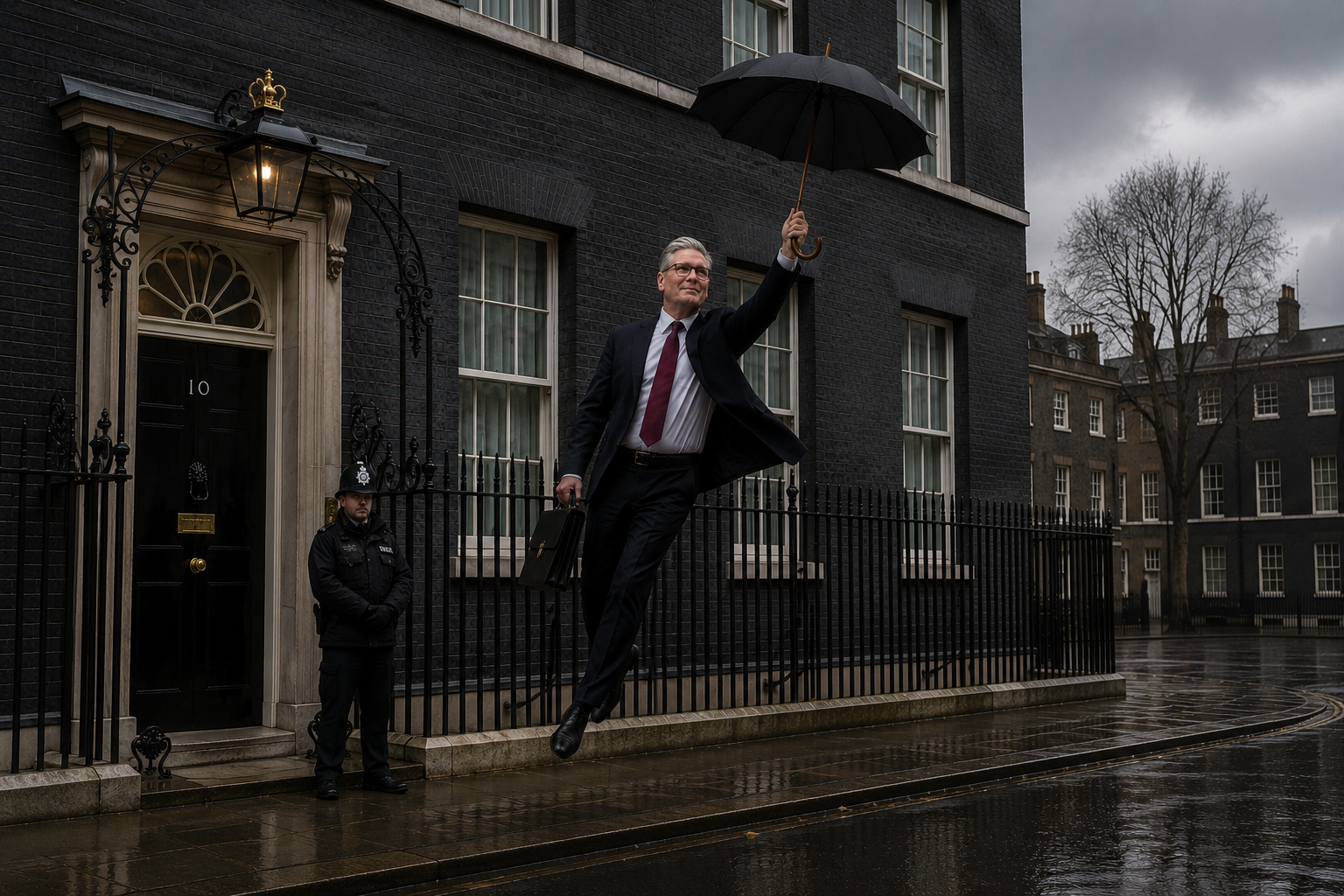
"When you need me but don't want me, I'll be... hang on, you neither want nor need me."
Ta-ta then, Keir Poppins. The nation's nanny leaves as we await our new leader. The seventh prime minister in ten years will again try to rule the United Kingdom as its people wait for them to fail.
It feels like Game of Thrones.
I'm unsure it matters which party you back these days. If this is how politics is going to run for the next decade, we might as well relax our common national interest in 'berate the leader' and go back to rolling cheese down hills.
I would like to say Keir has been awful. He and his team have hurt the growth agenda for years to come. But against the baseline of his terrible predecessors, I cannot say he was the worst, despite his ineffective, beige leadership and Davros-like voice.
His speeches were like watching cardboard. At the Labour conference, he did more PR for Reform than Farage. And his policies, often made by special advisors who are barely out of school uniform, were record-breaking for their U-turnability.
Starmer's (and Labour's) error was they failed to build and articulate a vision. There wasn't a common story everyone could buy into so he couldn't communicate with people and consequently delivered nothing.
The story is the strategy, ladies and gentlemen. People buy the story before they buy the goods.
Instead he divided the country - as if it needed dividing again - into 'working people' and those who don't fit that mould, including business owners, employers and leadership teams. It was a massive gaff from the start.
Washing machines would have provided more parliamentary charisma.
However he did three things well:
Firstly, the ban on social media for under 16s - if it still goes through, was sensible as a policy, but how it's enforced is another question. Secondly - he said 'no' to the Donald over bombing Iran, which took real guts. And third, he supported Ukraine without any doubt.
But the chaotic resignation roulette we're in today is really down to another man.
Cameron's legacy
David Cameron left two legacies when he resigned as Prime Minister.
He will be remembered as the man who thoroughly divided Britain.
And he will be remembered as the man who divided Britain and then ran away, paving the way for soft-chinned resignations stoked by blood-thirsty media.
I once went to a talk by a senior member of Cabinet who asked a very distinguished room, "Who here would be an MP?".
No one raised their hand.
"Exactly," he said. "This is the problem we have today. The media has made it so hard to be successful as a politician, very few people want to do it other than a particular personality type."
Doing a Cameron
David Cameron's resignation was, in my mind, the catalyst for much poorer UK trade and world leadership. His first push of the resignation flywheel has continued through to this government - and will probably move to the next as well.
Keir Starmer won a landslide in 2024 then and within two years was forced to step down today after his popularity collapsed, with a by-election victory by Andy Burnham in Makerfield triggering the final move. Burnham is now frontrunner to succeed him.
Growth mindset
We can look at this situation through many lenses, but the one this publication is interested in is growth, which requires confidence and a 'you-can-do-it' attitude.
Growth also requires a government that allows entrepreneurs, employers and leaders to create opportunities. Instead they have been overharnessed in regulatory seatbelts.
Keir's government showed great desire to redistribute wealth, but almost none to create it.
If you talk to sales teams and CEOs today, they will tell you "buyers are more cautious." The reason many of them cite is government leadership change, geopolitics and low confidence levels all around.
This latest resignation will not help.
The good news?
Regardless of how shit it gets in the UK, we will somehow always make it hilarious for ourselves. That is perhaps the charm of the British and the reason those of us who choose to stay here do so.
But too much of this is not healthy, even if it is funny.
And there is of course a silver lining to Keir's departure. Many reports now suggest that Rachel Reeves will be moved on as chancellor.
This is good news for anyone trying to run payroll, property, a limited company, a public company, a leadership tea, a small business, a freelancing business, a farm or to employ people. Or anyone trying to save money and aspire to buy things they would like to own.
That is for five minutes anyway.
The bad news is, given who is likely to be PM next, it could get a lot worse.
Hold on to your pensions.
Dan Ilett writes The Executive Summary for CEOs and leadership teams of the FTSE 350.
As a journalist, he has written for the Financial Times, the Economist Group, the Daily Telegraph, the New York Times and a string of tech publications. He launched a number of media titles including CoinDesk, where he was founding editor. Dan went on to lead transformation and advise on commercial delivery in FTSE and Fortune organisations.
To contact the Executive Summary, please reply to this email.

