
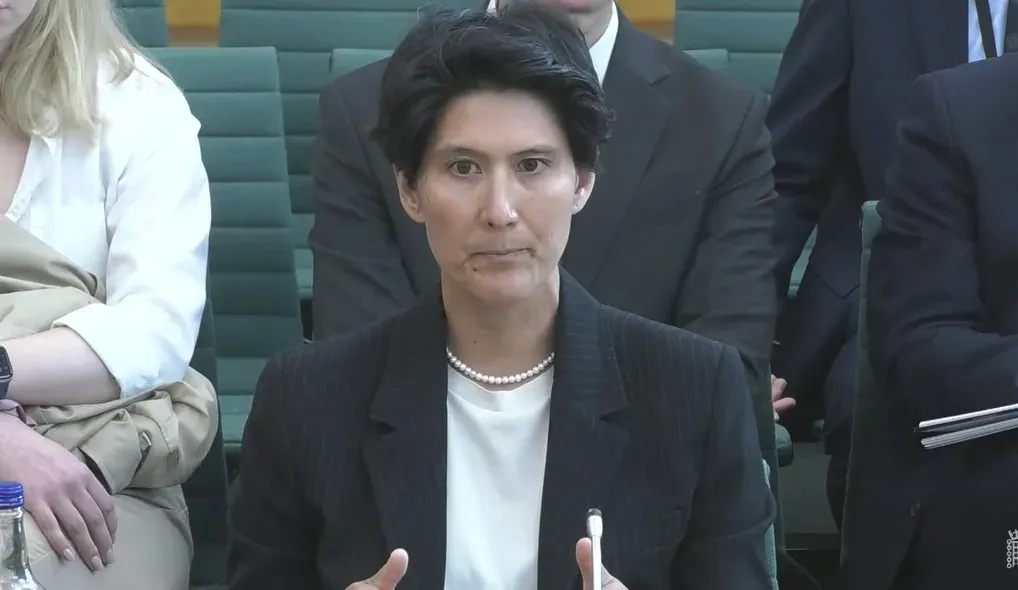
You don't often see wizards in public. But when they do come out, they tend to get noticed for their expertise in commanding and directing attention.
My father was a civil servant. He taught me about the fantastic use of English language senior civil servants have. They could talk for hours, saying nothing and suddenly bring your attention to something you'd have missed if they hadn't mentioned it. But it would never be pointed at anyone.
Command of the English language at this level is next level. Boss mode.
"In the middle of March, I had a meeting with Sir Olly and a senior member of his team," said Cat Little, the Cabinet Office Permanent Secretary, in yesterday's select committee.
"I specifically asked to see this document in any decision-making audit trail around those judgments. At the time, it was made clear to me that that information would not be forthcoming."
Cat Little is my new language hero.
In this last sentence, she uses a passive main clause, which removes the person making the decision. She then pairs it with a phrase that removes the action itself.
A meeting happened, she asked for documents and the documents then existed in a state of not-being-forthcoming - but they were not 'refused' in her language, as many newspapers have reported.
Little ran rings around a select committee investigating the appointment and vetting of Peter Mandelson.
Dull vs fascinating
The lesson for anyone who speaks in public is to know when to be unglamorous and when to be interesting. When asked questions you do not wish to answer, you must be dull.
Cat Little's defensive manoeuvres from her media training and legal advice were better than any politician I have ever seen.
"I took the very unusual judgment that I should directly request the information from UK Security Vetting," she said.
"Very unusual judgment" is the phrase that carries weight. Permanent Secretaries do not bypass other Permanent Secretaries casually. That is very interesting. She is leading people to look at this.
By flagging her own action as unusual she is telling the committee, without saying it, that something was badly wrong at the other end.
"I go back to my responsibilities to discharge the humble address, which is a responsibility that is unique to me and I take very seriously," she said.
"I felt that I needed to see some relevant documentation so that I could advise the prime minister as to whether we had fully complied and gathered the information that was available and within scope."
See if you can spot any similarities
The shield
A humble address is an old parliamentary procedure by which the House of Commons can formally demand documents from the government. It is a binding order, carried by resolution.
In February, MPs used it to force the release of documents relating to Mandelson's appointment. The convention is that the Cabinet Secretary or Permanent Secretary of the relevant department takes personal responsibility for ensuring full compliance.
This gave her rhetorical cover for everything that followed. When she bypassed Robbins to go straight to UK Security Vetting, she could frame it as "I had a legal duty to Parliament that I could not fulfil through the normal channel."
That kept her argument safe and dull. She didn't need to point the finger directly.
When she decided what to tell the PM, she could frame it as discharging an obligation to the Commons rather than as a political judgment.
When she was asked about the "very unusual" step of going direct to UKSV, she reached for humble address every time.
This disarmed the line of attack from the committee, which is "why did you not tell the PM on 25 March rather than 14 April." Her answer is: I was processing a parliamentary order that required me to work out exactly what was in scope.
Very good use of messaging.
Whatever the outcome of the Mandelson-Starmer cockup, and who takes the fall for it, I was so impressed by her ability to deliver a tough message and stick to the plan.
Wizard.
What kind of mess is Starmer in?
For anyone trying to make sense of the Mandelson appointment, vetting and subsequent actions by Keir Starmer, here is an executive summary to help you.
Starmer wanted Mandelson as ambassador to Washington. The appointment was announced on 20 December 2024, before vetting was finished.
Three days later, vetting began under Sir Philip Barton as Foreign Office Permanent Secretary. Barton left the role in January 2025 at the end of his four-year term. He has been called to give evidence to the Foreign Affairs Committee on Tuesday 28 April.
Olly Robbins took over on 20 January 2025. Eight days later the UKSV report landed with two red flags: high concern and clearance denied. The Foreign Office under Robbins overrode the recommendation. An email from the director of security set out mitigations. Mandelson got his clearance and went to Washington.
It held until the Epstein files broke. Mandelson was sacked on 11 September 2025. Leaks about the vetting process started appearing in the press.
In February 2026, Parliament passed a humble address demanding all documents.
Cat Little at the Cabinet Office was put in charge. In mid-March she asked Robbins for the papers. He did not hand them over. She went direct to UKSV, read the report on 25 March, took legal advice, and told Starmer on 14 April.
Starmer sacked Robbins shortly afterwards. Little had not yet seen the mitigations email. Nobody briefing Starmer had. He fired his Permanent Secretary on the UKSV recommendation alone.
After the sacking, the email was produced. Little has read it. Starmer has been briefed on "relevant information" and has spoken to Robbins directly. Exactly what he has read since, Little will not say.
Robbins gave evidence on Tuesday. Little on Thursday. Morgan McSweeney, Starmer's chief of staff when the appointment was made, is up next Tuesday, alongside Barton.
The remaining questions
Who took the formal decision to override UKSV, given Little said on the record it was "not entirely clear" to her.
What was Barton's view of the Mandelson appointment and is that view documented?
Why did Foreign Office officials request Mandelson's vetting file on 15 September 2025, four days after he was sacked - and who read it?
Why is there no minute of the meeting at which Starmer decided to appoint Mandelson?
Has Starmer now personally read the mitigations email, or is he still operating on the same partial evidence he fired Robbins on?
Who in Number 10 knew about the UKSV recommendation before 14 April?
Most of those threads lead back to two questions: who decided to push Mandelson through - and why?
A real whodunnit.

