
Last year Dario Amodei, who runs Anthropic, warned that AI could replace up to half of entry-level office jobs within five years. Investors and boards started to act on it while consultancies built practices around it.
But Dario's warning missed one crucial variable.
Corporate shitness.

Corporates are caked in regs and 'say no' culture
While Silicon Valley races to keep pace with Chinese AI labs, large businesses plod along at a completely different speed. Even the ones that want change, and plenty don't, cannot move at the pace Silicon Valley has banked on.
Decision making in big companies has slowed over recent years, as many executives will attest with heads in their hands.
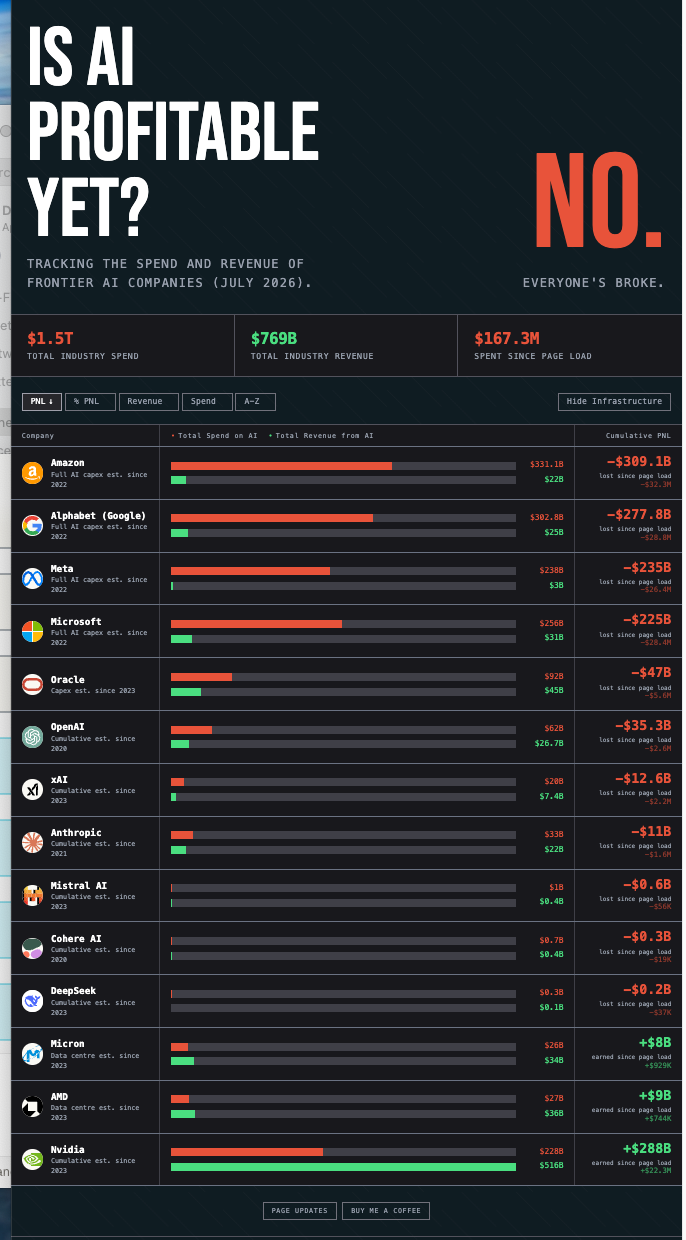
This presents a number of problems for AI companies who are burning money and running down the clock.
An EY-Parthenon survey found the share of CEOs who think AI will cause major job losses fell from 46% in January 2025 to 20% by May.
As MIT economist David Autor put it, they may have noticed the market failing to implode on schedule.
No matter how authoritative the author, AI predictions have been quite terrible to date. The World Economic Forum predicted in 2018 that AI would erase seven million jobs globally by 2022. Researchers who reviewed AI job forecasts going back to 2017 found little of it had panned out, concluding that wild inaccuracy of such reports is their common attribute.
It would appear that forecasters have been measuring the wrong thing - what technology has promised to do vs what it can do vs what organisations can or will absorb.
The first is supply led. The second is demand.
It is widely citied that MIT's State of AI in Business study found that despite $30-$40 billion in enterprise investment, 95% of AI pilots delivered no measurable profit and loss impact. S&P Global found 42% of companies abandoned most of their AI projects in 2025, more than double the year before. Morgan Stanley found only 21% of S&P 500 companies could cite a measurable AI benefit at all.
From these numbers, boardrooms have settled on a convenient story. AI is overhyped. The returns were never there. Gartner's trough of disillusionment is right on schedule.
I have a less comfortable reading. The 95% failure rate tells us nothing about the technology and everything about the organisational mindset.
If AI genuinely lacked value, small firms would be failing with it too. Just look at TikTok for five minutes and the small companies creating products overnight and selling them.
In the AI world, small is beautiful.
According to the US Chamber of Commerce, 98% of small businesses now use AI tools daily, up from 40% in 2023. Stanford's 2026 AI Index found that only 29% of companies see significant ROI from AI, and that successful minority is increasingly concentrated in the mid-market, with mid-market firms outpacing enterprises on deployment speed.
One founder of a 90-person accounting firm put an AI document extraction tool into production in nine days for $8500. The equivalent project at her former enterprise employer took 14 months and $1.2 million.
In a regulated corporate, a new product runs through at least 14 approval gates before launch. Most of those are committees that meet monthly with papers due two weeks ahead.
This is the biggest problem corporates have - process turds.
They prevent growth at pace and set a burden on operational delivery. It's safer for everyone to say 'no' than gamble their career on a 'yes'.
It's a people problem
Ask a CEO what they need this year and they'll say:
- Revenue growth
- Cost discipline
- Speed to market
- Better customer experience
- Talent retention
- Compliance help
- Resilience against geopolitical shocks
- AI to enhance the business
Over the past two years, boardrooms have collapsed all eight into a single answer:
AI.
And that has to be bollocks.
Now I'm not pooh-poohing AI. I'm questioning the competence and relevance of leaders in tier-1 companies as I see smaller firms racing ahead and enjoying new capabilities they couldn't afford before.
Harvard Business Review found that managers in large firms want AI tools that help with today's work while executives want transformation initiatives that look good in board decks. That selfish board or exco team mindset to avoid being thrown under the bus adds months to every deployment.
But in a small firm it does not exist. There is no incentive for it.
Some 90% of employees report daily use of personal AI tools even though only 40% of firms hold official subscriptions. So 'value' or 'work' is being created inside these companies right now, but it's unsanctioned, unmeasured and invisible - to the absolute horror of the company. They have no control over who is gaming the system.
A CIO from a small bank ( a member of the City CIO Club, which I chair) told me:
"We've taken testing times down from 10 weeks to one week. We've kicked out a number of SaaS providers and we are making things for ourselves now.
Some of it needs extra help, but a lot of it we're able to get running for the business and show 95% cost savings. It means we can deploy budget on things that turbo charge customer acquisition."
Turning point
I think this is the inflection point in AI I've been looking for on Jevons Paradox.
In 1865, William Stanley Jevons noticed that making coal engines more efficient increased Britain's coal consumption thereby increasing pollution because cheaper power created more uses for power - and an abundance of it. The law plays out in all efficient tech - LED lightbulbs, the paperless office, the carburetor etc.
Apply that to AI and some functions will hire, not shrink. But this will start and show value via Maslow's hierarchy of needs most obviously.
State-sponsored hacking farms now bombard organisations with more attacks than any human team can triage. However reluctant chief information security officers are to let AI into their world, at some point they will have to accept they need it - and will need more people to supervise it.
This type of work multiplies faster than the automation can absorb it - and I don't think people have budget for this. It creates tech debt and all sorts of chaos the company needs people to help with.
So will AI take the roles it was forecast to take last year? In large companies, far fewer and far slower, for exactly the reasons above.
But the comfort in that sentence is false for tier 1s. The threat to the corporation is not AI hollowing out its headcount. It's now the smaller competitor who absorbed the technology in days while your fourth committee was reviewing the risk-gate committee notes.
When a big company says AI has no value, it's more likely to mean - our ability to create, test, fail, fix and repeat is something we can't do fast or won't do. Yet AI native companies are moving at lightspeed.
Your AI roadmap is where to focus. It will enable you to make the right choices to harness AI without falling down the rabbit holes others have. If you'd like to explore this with me, send me a note. We can get you up to speed fast, help you to build the AI roadmap and lock down your governance controls so you're in charge.
Reply to this email and let's talk.

