
I'm a little slow on the email trigger this week. I've been stacked in meetings, workshops and dinners for days, so here's a rough and ready one on what the market is actually saying. Please forgive typos etc as I have rushed a bit.
Every business question of matter is framed around AI. Here are six things I keep hearing.
1. Hand sanitiser startups
There is a wave of startups who believe they have built the next big thing without ever validating the product. This is the danger of building in silo.
During Covid, lots of people started making hand sanitiser because for five minutes it was a valuable product in short supply. Five minutes later the market caught up and the business evaporated.
We are about to see the AI version of that, at scale.
These companies are extremely fast to build with low barriers. Their problem is go-to-market, and speed of build makes the problem worse because everyone else is fast too.
The biggest issue is people building are applying old-world rules: "No one has had this before. This is rare. This is so valuable."
It's not. It's dirt cheap and you can buy it at Poundland with a free Twix.
What is useful is the next step - the niche data sets you can integrate and your expertise. In this regard, it is humans + AI that makes the difference. People who deeply understand problem sets and bring value add above average.
See video below for where industry stands today.
2. 10k companies, one product
Many of these startups are building genuinely brilliant technology in remarkably short time.
I initially saw this with LinkedIn AI outreach tools a couple of years ago. People were contacting me on Tiktok for go-to-market help on apps that would run prospecting.
It was a good idea, but there were hundreds of them doing the same thing. Once one person sees your idea, it's easy to steal - if it's not baked in serious technology and expertise.
And even if it is, these companies are hitting two walls.
The first is getting anyone to implement it, use it and pay for it. More on that below.
The second is subtler. To solve their chosen problem, the building team usually ends up creating a general platform, a set of agents, rules and workflow tooling that happens to be pointed at one use case.
I saw an agentic platform for forensic accounting recently that runs on an engine capable of deep analysis and workflow automation almost anywhere in a business. The founders think they have a forensic accounting company. They have an orchestration engine wearing a costume.
Multiply that across the market and you get tens of thousands of platforms, each convinced it is unique and that it can transform business out of its use case.
That's another go-to-market danger. Generic tech with no use case to call home.
Microsoft, Salesforce, IBM, Google and the rest have shipped enterprise agent platforms and procurement processes are forming around them. The orchestration land grab is underway.
Winners TBC.
3. Tier 1 is stuck and the sweet spot sits below it
The biggest companies are at a serious disadvantage.
People in my community tell me they are now helping Big Tech firms, the ones selling AI products and claiming AI leadership, to become more AI fluent. That's because no one is getting the time to learn AI properly other than - startups, who lack market context.
To be fair, everyone lacks market context right now.
But tier 1 firms are stuck because they are so slow.
The AI rate of change runs in days. New models, releases, capabilities are weekly.
Big companies set their training budgets in half years. On the buy side they are struggling to work out what to buy from whom. On the sell side, the big firms are bringing decent solutions to clients who feel no urgency to move because it's whizzy not critical.
I would go as far as to say Tier 1 is paralysed, by fear, lack of insight and by an inability to respond at the speed the market now demands.
Tier 2, on the other hand, the mid-market and large SMEs sit in the sweet spot.
Their challenge is internal transformation, which is once again a go-to-market problem in disguise.
4. The IPO jitters
The trillion-dollar AI company IPOs are spooking buyers and I'm hearing three distinct messags.
"They'll put the price up 20x once they've done the IPO. They can't subsidise this forever."
"It feels like a Trojan horse."
"Wait until the open source models catch up. Their market will be in pieces and there will be a crash."
Quite simply, without the IPOs at huge valuations, AI companies will struggle to maintain pace.
Companies are playing with AI but holding off on adoption because they fear the pricing rug-pull, and some are quietly hedging toward open and sovereign models as insurance.
5. Pilot jail
Although the study is one year old and probably out of date now, MIT reviewed more than 300 enterprise AI initiatives and found that 95% delivered zero measurable return.
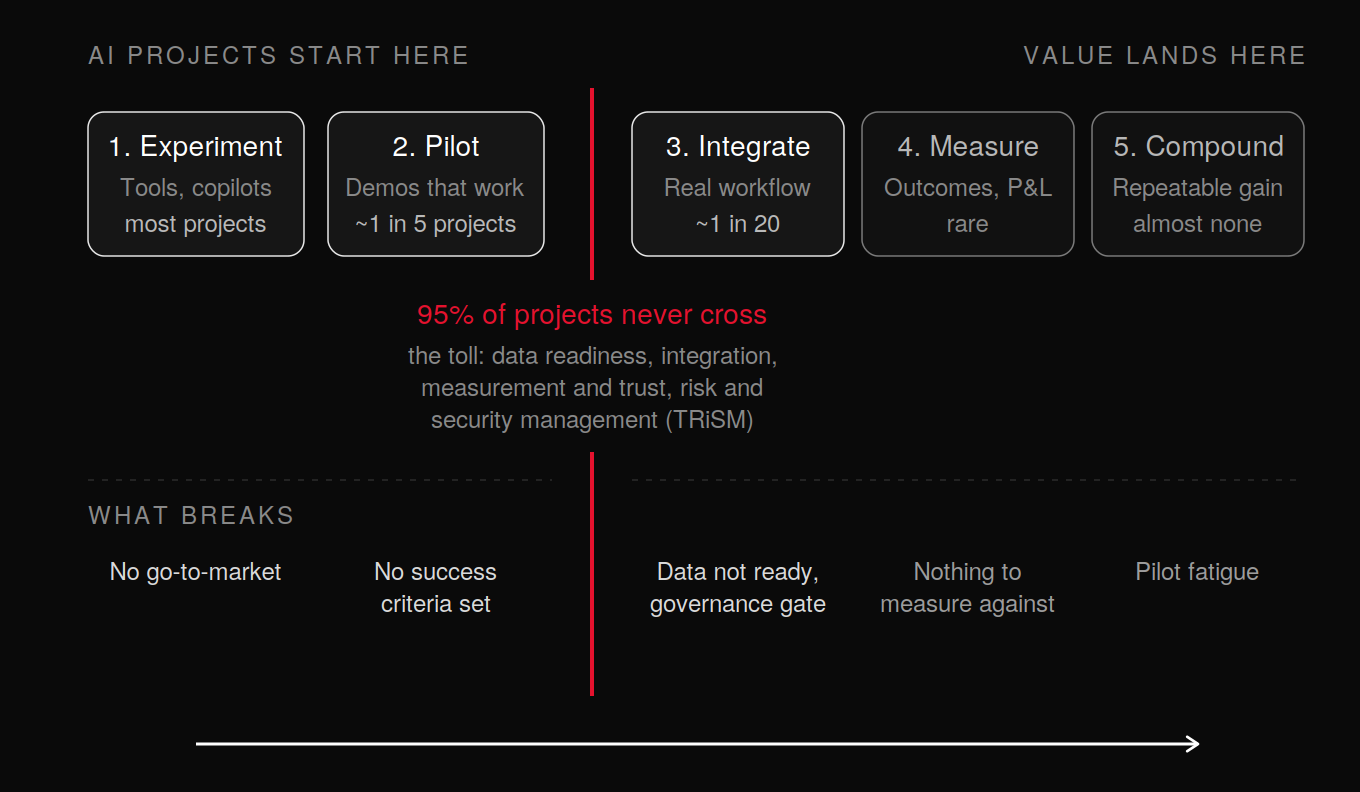
They die because most pilots launch with no success criteria, so there is no way to declare victory even when the technology performs exactly as designed.
The outcome rate is low but the token usage is high. While tokens are cheap, that's not a problem. When tokens go up, outcome rate will be scrutinised.
Pilots die because roughly 80% of the work of getting from pilot to production is data engineering, integration, governance and measurement, the unglamorous middle nobody budgets for.
And after the third failed pilot, executives stop showing up to the reviews.
Integration is the biggest blocker to success right now.
6. TRiSM
AI trust, risk and security management (TRiSM) is a Gartner framework that is becoming the procurement test every AI vendor has to pass.
Buyers now want an inventory of every model and agent in the building, a map of the data feeding them and runtime controls that catch an agent doing something it shouldn't.
Control - or lack of it - is the driving force here. Please refer to The Safety Advantage framework if you need help with this.
The shape of it
I don't get the impression many people really know what's happening in AI with pinpoint accuracy.
At dinners, there are a lot of snippets and views, but not much to bind them together yet, which means AI adoption is in its infancy.
This is dangerous for any company that has only applied mild validation to its pre-go-to-market work. New AI teams believe they are solo building god when they're actually building a plastic model of He-Man in a LEAN factory designed to give your co-workers the instructions to do the same.

Book The AI Stress Test workshop with Dan
If your company is struggling with how to use AI or what it should (and shouldn't) be doing, book an AI stress test with me. In a one-day workshop, I help you work out what AI means for your business, where it will pay back fastest, and how to think about the choices in front of you. Plus what to avoid. Brutal clarity you can act on in one day. Book it NOW.