

I had coffee with one of my friends from school yesterday. He works for one of the big banks and he said:
"They keep asking us how we're using AI. What use are we getting out of it? Where is it helping? I'm f***ing sick of it."
This is global PLC right now. They have drunk the Kool-Aid and bought the AI products but with no real plan.
"Do AI," the leadership team says, but the reality is completely divorced from the Silicon Valley dream that's been baked into your IT licences without your permission.
Small companies don’t have that problem. They just use it for what they see they need it for. They have permission to move fast - whereas big companies do not.
So how do you get started in a large company?
Let’s deal with it. This is a first of a number of articles on achieving AI productivity.
Removing the mundane
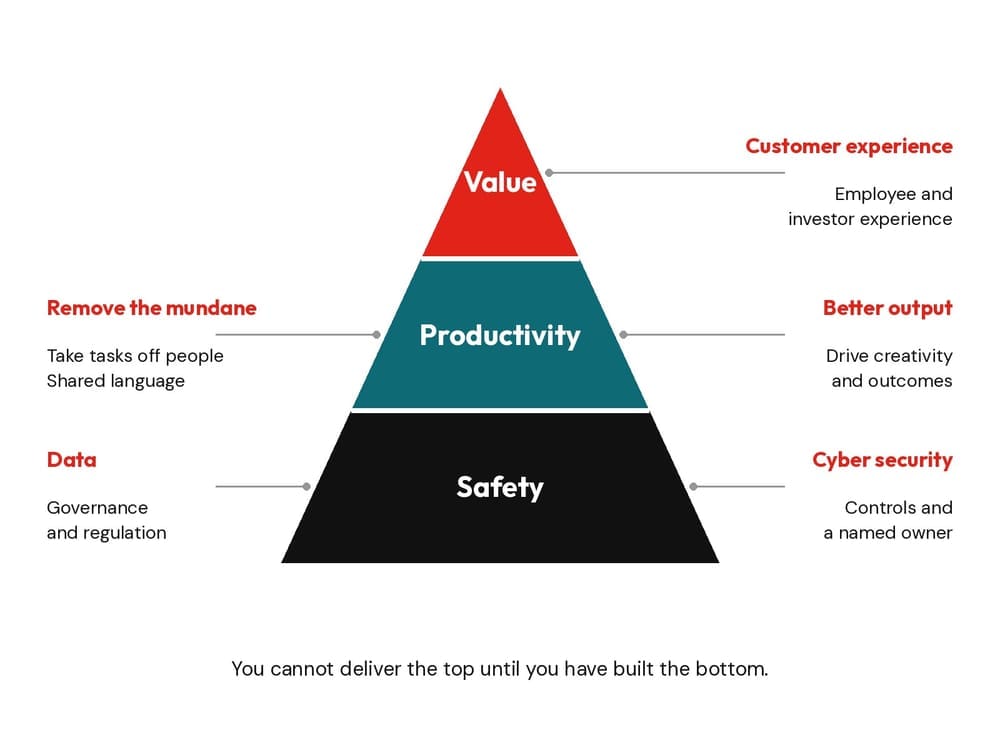
If you've read the previous AI strategy triangle articles, you'll know we always start with safety. So you have to get those things right first.
For productivity, there's no better place to start than with you. If you can work out how to use AI to make your own productivity better, you will know how to apply it everywhere else.
You need a lens
If you start on this journey with a blank sheet of paper and an AI prompt, you will get a random bunch of results. That is what happens to almost everyone who opens one of these tools with good intentions and no structure.
You need models, frameworks and lenses through which to see the AI world.
I should say up front that what follows is how I run things rather than a neutral summary of a management book.
It comes from carrying programmes and teams that were bigger than my head, where the only way through was deciding, every day, what I was going to do and what I was going to hand to somebody else.
The AI Eisenhower Matrix
In August 1954, Dwight D. Eisenhower spoke to the Second Assembly of the World Council of Churches at Northwestern University. He quoted a former college president, whose name he never gave, saying he had two kinds of problems: the urgent and the important. So you can categorise them.
- Schedule
- Do it now
- Kill it
- Delegate
Eisenhower liked the model because it described his own life. He had run Operation Overlord, the Normandy landings and the campaign across northwest Europe. He was also running a country, so he had a strong view on what needed his time.
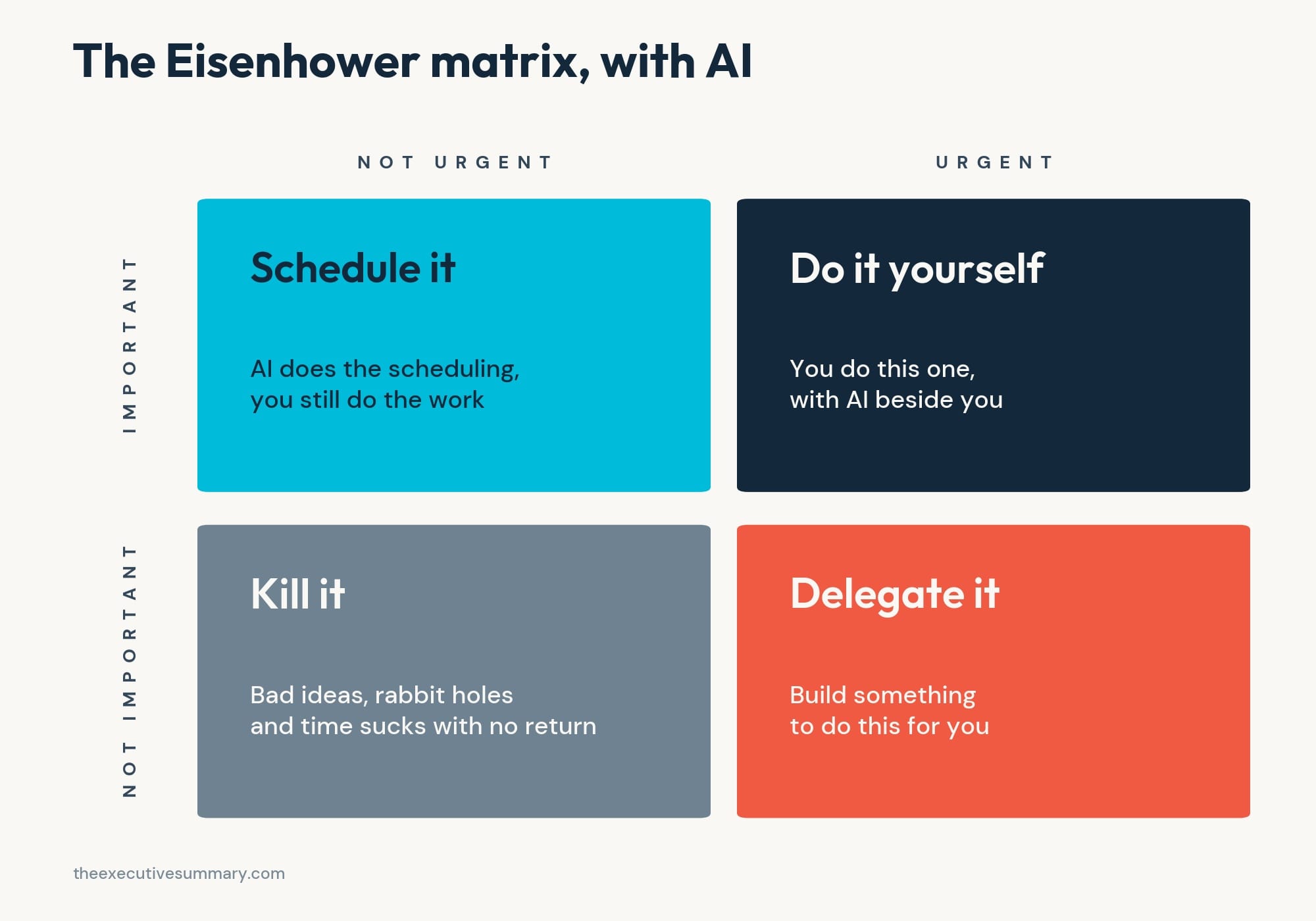
The 2x2 grid we see here was built 35 years later by Stephen Covey in The 7 Habits of Highly Effective People based on that idea.
When I get overwhelmed, this is the diagram that comes out.
Do it yourself
Urgent and important.
This quadrant is yours, but AI is your thinking partner, checking your reasoning, drafting the awkward email while you decide what it should say. These are tasks that require your judgement.
When you are running something large, almost everything arrives dressed as urgent and important, because that is how people get your attention.
Half of it belongs in another box, and deciding which half is your job.
Schedule it
Important and not urgent.
Whatever you decide to schedule, which is usually meetings, learning, jobs that require focus but not now and only-you admin, AI should do the scheduling.
Obviously, you still need to be involved in your important tasks, but not in the diary work. If you have set up your agent correctly, they will be able to manage your diary and scheduling conversations, cutting out the time it takes you to get your calendar sorted.
Start with a scheduling agent
Here are three ways to do it, in ascending order of ambition. If you are a PA or a chief of staff, this will change your week.
1 - Switch on what you already pay for.
Your calendar and mail almost certainly include an assistant now. Ask it to find the slots, hold the blocks, flag the clashes and put a short briefing in front of you the night before. This costs nothing extra, needs nobody's permission and takes an hour.
2 - Write the rules down once.
Open a project in whichever tool you use and tell it how you work. For example, no meetings before 9.30. Tuesday mornings are protected. Travel counts as working time.
Mine knows I prefer to work in the City, which days I take coffees and where, and when my call slots are. It also knows how and where I like to run my workshops.
Every Friday afternoon, we go through the week ahead and the emails I have missed.
3 - Build an agent.
An advanced AI scheduling agent is something running on its own environment, connected to your calendar and your inbox, that you talk to from your phone.
It moves things, chases confirmations and briefs you before each meeting. This is the point where your diary stops being your problem.
I know this sounds simple, but it puts you ahead of the people still being asked what use they are getting out of AI.
Scheduling should be AI'd first as it's a really easy way to show ROI.
Delegate it
Urgent and not important.
This is the interesting box for anyone running a team or a programme. You now have a choice you did not have three years ago.
Do you give this to a human or an agent?
The answer depends on how prepared you are, which is different in every organisation and precisely why "do AI" is such a useless instruction.
Before you ask - we will do a proper post on building agents. You can also come to the Executive Summary‘s leadership cohort on working with agents. Email me for details.
What can I delegate?
It doesn’t really matter what AI tool you use to start, just start.
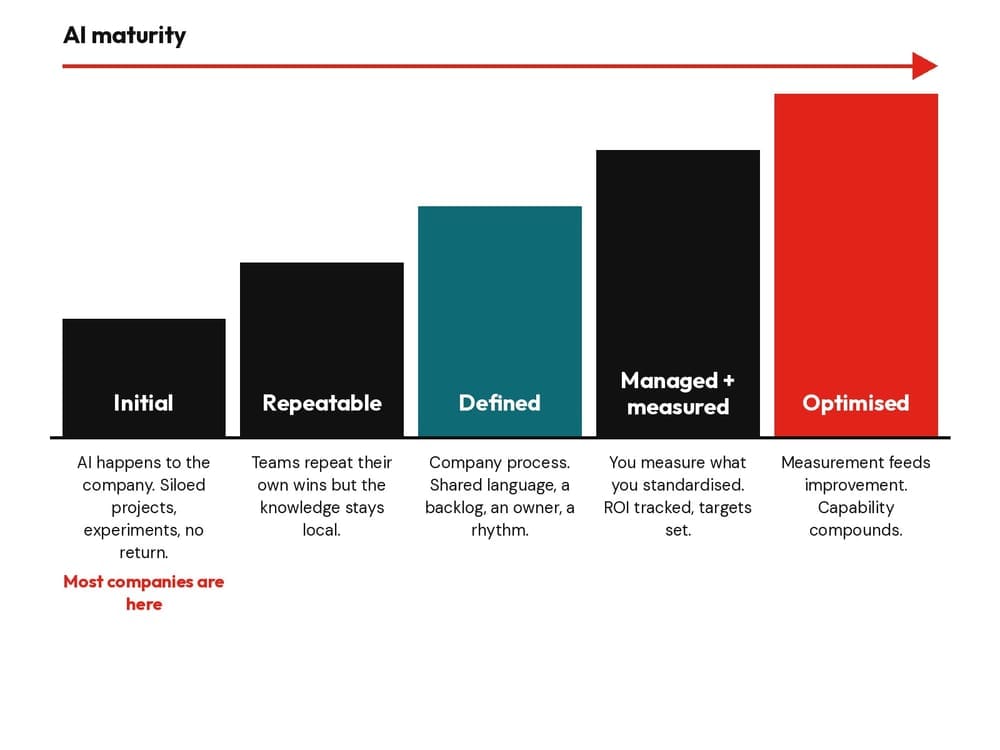
In the strategy article I put businesses on a five stage maturity ladder, running from Initial through Repeatable, Defined and Managed to Optimised.
Delegation maps onto it, which is the honest reason "do AI" fails. What you can hand over depends on the strength of foundations you have built.
Running through the Eisenhower Matrix - especially with what you can delegate - will immediately help you to move to repeatable and defined.
That still leaves one question. Who gets hurt when it goes wrong?
Blast radius
Prioritising what to give to AI should be led by the potential win, the cost and the risk. Like any good decision.
Think about as blast radius, meaning who carries the cost when the agent gets it wrong.
I've said before that companies want to go straight to the AI value proposition without doing any of the above. Things will go wrong, and the further out you started, the more people they go wrong for.
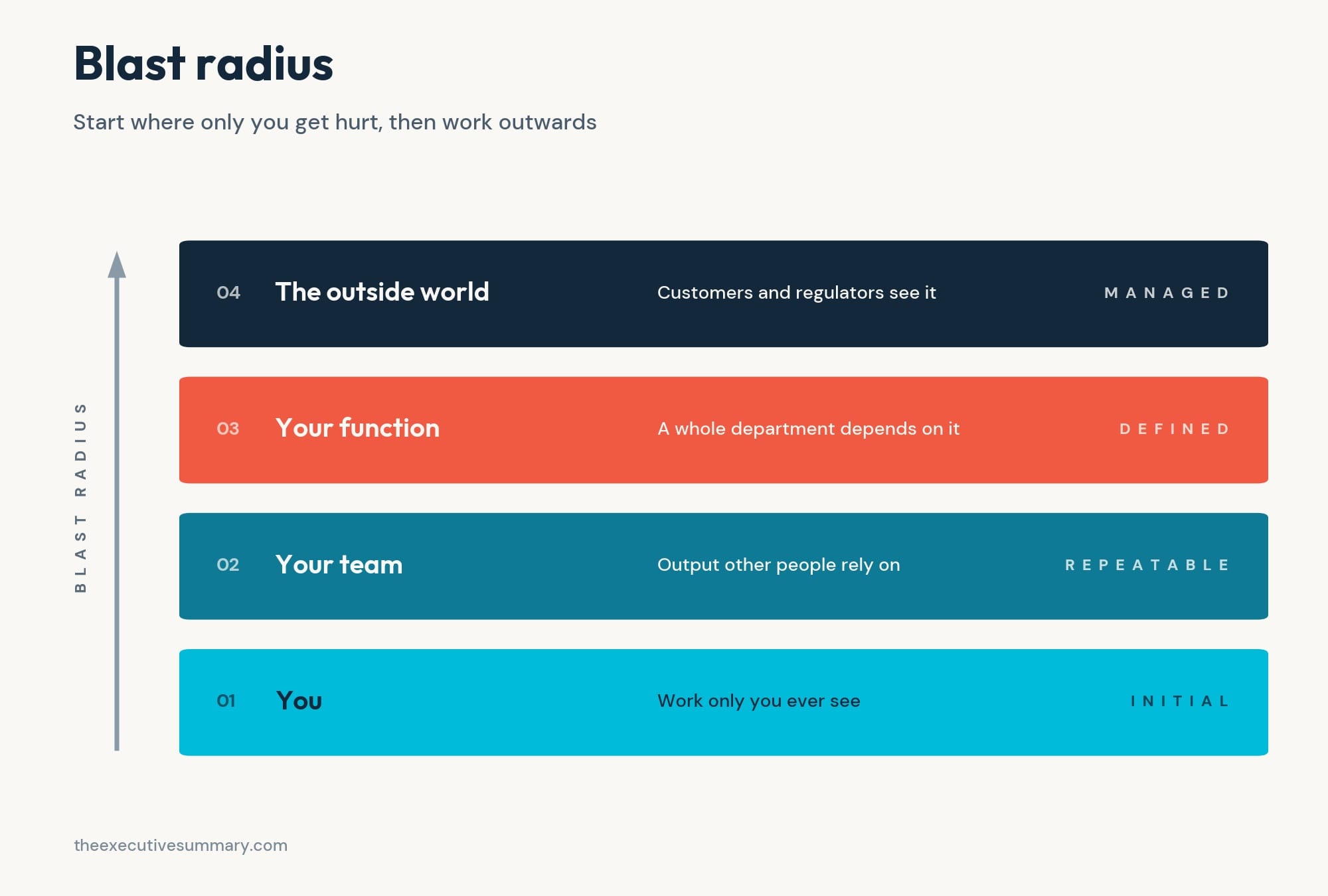
This is why the Eisenhower matrix works, because it starts with you.
Rung 1, you.
Any company can start here, even at Initial. Work that nobody else sees, such as your diary or reading - or even the first draft of something you will rewrite.
This is the place to learn, because when it fails the only person who pays is you.
That is also why it is the right rung for a leadership team in a business that has done nothing yet. You do not need a policy to let an agent tidy your own week.
Rung 2, your team.
"Can you get me the report on X?" "Can you send me the data on Y?"
Regular data retrieval is repetitive; it follows a pattern and carries almost no judgement. Once the system is built it runs forever. Dashboards and access requests sit alongside it. Other people now rely on the output, so it has to be right and it has to tell you when it has not run.
Start here after yourself, because it is the least risky thing you will ever automate for somebody else, and because it buys you the credibility to do the harder ones.
Rung 3, your function.
A whole department depends on it.
For example:
In HR, the same policy question answered 40 times a week, first-draft job descriptions, onboarding packs and the synthesis of exit interviews into something a board can read.
In IT, the reported wins are in test generation, first-pass code review, documentation and release notes, which is where teams say they get build cycles down.
I know one CISO who has completely removed his very large backlog of vulnerabilities by using AI. To do that safely you keep a human approving every new or big decision, and the agent never holds production credentials. Nor are they ever trusted.
In finance, you can do variance commentary on the month-end pack written from the numbers and checked by an accountant, reconciliation exceptions surfaced rather than hunted, supplier contracts summarised against the terms you care about, and debtor chasing that happens on day 31.
Last year, I built a timesheet-fraud detection tool for a company that was struggling to see where contractors and agencies were overcharging or stealing.
Each of those needs different data, carries different risk and answers to a different regulator, which is exactly why a company-wide instruction produces nothing.
Therefore each department needs to be fluent in company AI so they can build their own backlog and speak the same language.
Rung 4, the outside world.
This needs great care.
In this rung, customers and regulators now see the work and this is where it gets delicate.
I think Octopus Energy built their AI well.
It ran its AI assistant Arlo internally before it ever met a customer, and the trial came back at 76% customer satisfaction against 72% for comparable human responses.
Air Canada tried to climb straight to this rung and ended up in court over what its bot said.
Be straight with people
It’s worth noting that Article 50 of the EU AI Act applied from 2 August 2026 says that systems that interact directly with people have to make clear that they are machines, and deepfakes and AI-generated content on matters of public interest have to be labelled.
Penalties can reach €15m or 3% of worldwide turnover.
In other words, if you have an agent called Mickey talking to customers in Europe, you are obliged to make sure they know Mickey is a machine.
Think about that as etiquette rather than compliance.
Say you are at a dinner and a client asks whether you could put something in front of them. You know your agent can draft it overnight and you can spend 40 minutes over breakfast finishing it.
The instinct is to say nothing about how and let them believe you sat up until two in the morning.
But the better answer is:
"Would you mind if we used AI to do some of this? We could get it to you for 8am. It'll be faster and cheaper."
Everybody has or soon will have the same tools. What you are offering is speed and openness about how you work rather than cleverness. Trying to pass machine work off as your own unravels fast, usually in front of the person you most wanted to impress.
The same rule applies inside your business. Tell your team what your agent does and does not do.
Final quadrant: Kill it
Bad ideas, rabbit holes, and the time sucks that return nothing. Don't get AI to do these, nor anyone else - nor you.
Watch out for the moment your organisation starts using AI to industrialise stuff it doesn’t need. It's happening everywhere and it’s like throwing money down the drain.
Be vigilant over your time.
Do this now
- Sort next week into the four boxes
- See what you can give AI to schedule
- Take the thing in your delegate box that annoys you most and write it up as a prompt - see what comes back
- Anything n the kill box that other people are feeding, kill it publicly so everybody knows they can too
- Then decide what you would say at that dinner
Good luck
Dan