This is the question I'm getting all the time in my conversations in the City.
Here is my framework for getting through it.
You may know that for the last 15 years, I have built value propositions, messaging and go-to-market plans for some of the fastest growing companies in the world. I've helped them to land deals and drive huge value in the existing client base too. I've built and led consumer propositions at FTSE and startup level.
So I think it's fair to say, I've seen my fair share of what works and what doesn't. It ALL comes back to mindset and culture.
But the truth is, from all my conversations, AI has a lot of companies stumped. They don't know what they should be selling and the things they're trying aren't working.
The reason is that they as individuals are in a state of change.
You know how when someone dies, it's very hard to believe they're dead for a while. The same thing is happening now. The old way of work was that if you built a piece of software that solved a problem, it was very quickly valuable.
Now it's not.
Pretty much anyone can pick up an AI tool and make a good amount of software if they really want to.
That shift in mindset is really hurting companies. Leaders know something has changed but they can't put their finger on what. It's stopping them selling and buying.
Thanks to The Executive Summary, people now book calls with me to ask for help. The biggest question is "what's our AI proposition?" and they don't really like the answer because it's hard to swallow.
So here it is.
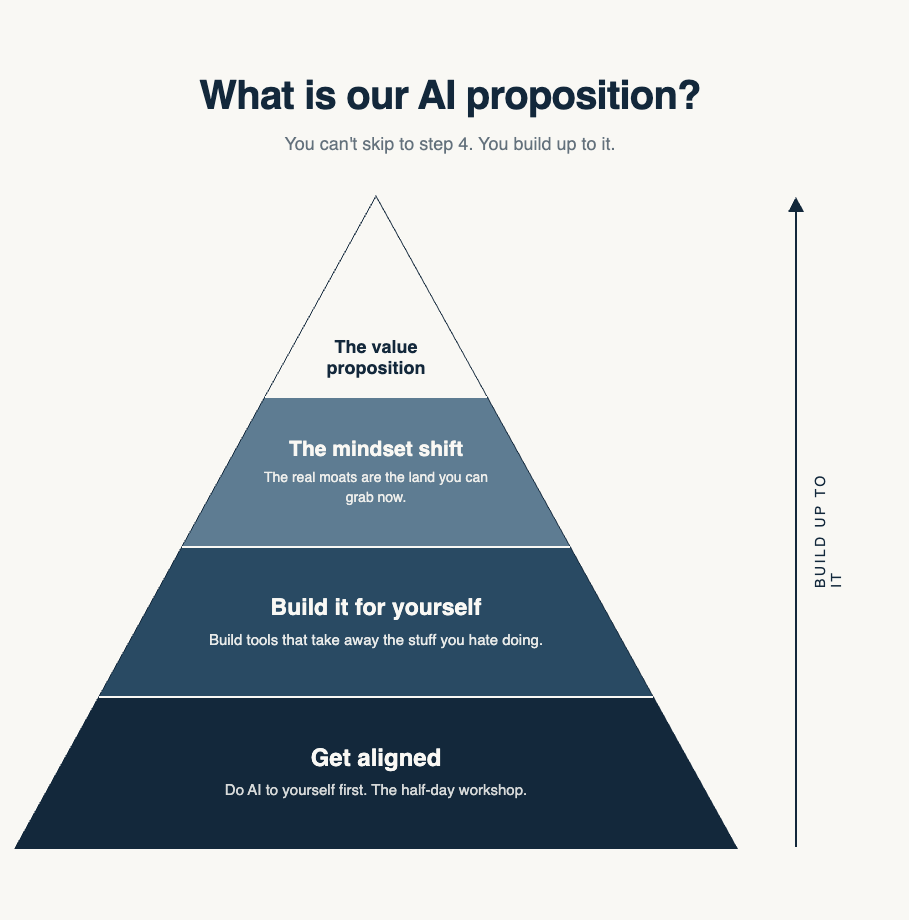
Step 1: Get aligned
There are a few obvious places AI will sit with your clients, but they will be thinking about doing it themselves. So if you want to remain relevant, you have to do AI to yourself first.
By that I mean your entire leadership is aligned. They understand the context of the AI market and what it means for businesses. They know what is right and wrong. And they all speak a common language, so they can use the tools together. That's a half-day workshop. It's very fast, and in doing it you realise as a team what your company needs to do, who is responsible and where your risks lie.
One of the biggest challenges leaders and employees have is time. I'm seeing companies get left behind because they simply don't have the time to sit down and learn how to use the tools properly. They're asking AI to write an email or find a good restaurant.
Some people in your organisation have probably already started building. They might be techies, they might not. But in many cases these are personal projects of people who are learning how to use the tools while they watch the football. I can tell you a number of Fortune tech companies who sell AI are in this exact position. They are hiring people to help them understand how they use and sell with AI. They are getting on the same page.
Getting your leadership aligned is exactly what the workshop does. If you already know your team needs this, you can book a time to talk here.
Step 2: Build it for yourself
You then start to build, and right now a lot of people are building things that will never see the light of day. What you should be building are tools that take away the stuff you hate doing. Do it for you first, or your family.
My son is Type 1 diabetic. He's 11, which means managing diabetes is a real pain in the backside for him sometimes. The doctor can be difficult to deal with and he gets fed up of his mum and dad nagging him to give himself insulin, change his kit or prevent hypoglycaemia.
It's a tough gig for him and I really feel for him. It is a lonely path for only the most resilient mind.
So I built him an AI agent for his phone that he can talk to and that can educate him. The app is called "Eleven" after the character in Stranger Things, and it has gamified his diabetes education.
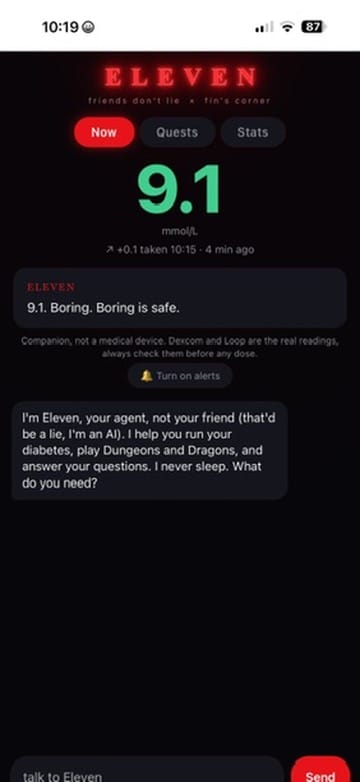
Eleven plays Dungeons and Dragons with Fin, but also gives him points if he does the right thing, such as give himself insulin for meals or change his kit on time. She can talk to him about anything, but I have put some parental guardrails in place.
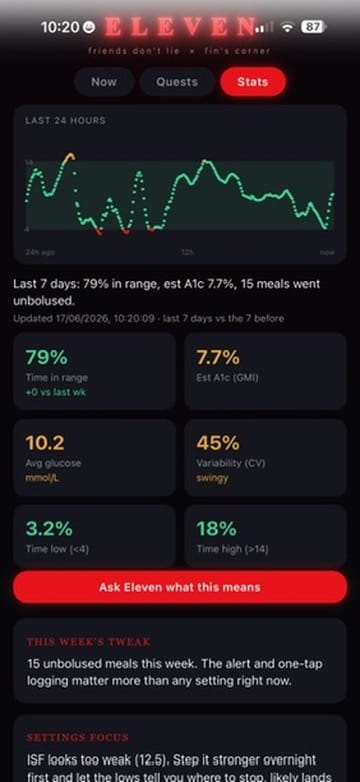
From a technical perspective, I took his diabetes tracking data from a tool called Nightscout, so Eleven can talk to him about what's happening in real time. She also has a PhD in blood sugar management, data analysis and diabetes tech. She (a version of Claude Haiku because it's cheap) uses several official databases for best-practice discussions - and has read a lot of forums.
She often points him at facts, so it's a little bit by little bit.
He loves it.
I have also moved my entire business onto an environment that AI manages, built on a platform I can plug any AI tool into. That has taken a lot of cost out of websites, plugins, hosting, CRM and content management. For your business, this is where you should start. Take out the cost of things that don't matter.
I am now helping a marketing firm to AI'ify their business.
But in doing this. you'll quickly see the huge number of rabbit holes you can go down. If you have an idea, you can build it really fast. That - to the untrained mind - is addictive. There are a lot of people building stuff that will never be used purely because they can.
The last thing you want is more tech debt.
Like a Jedi, you must adopt a disciplined mindset to only build one thing at a time. You can have several builds going at once, but the aim is to get one into production.

Step 3: The mindset shift
Once you have been through this, and the building never really stops, it's time to realise what's really going on. Your clients are doing exactly the same thing, so you have to look at what they really need that they can't do for themselves, versus what you have.
You also have to realise you aren't an AI company, unless you genuinely are. You are what you were before, and you are adding AI to your capabilities, as every other company is too.
People often ask "what's the moat?", meaning what is the defendable position we have. I would argue a lot of the moats have gone.
The real moats are the land you can grab now. You need to be fast and aggressive rather than comfortable and fat.
The land grab is showing your customers you have already transformed internally.
You already have leaders who have agents doing some of their work. Just for a moment, imagine you and your competitors now all have the same AI capabilities, and so do your clients. If you're not first to get the contract, you'll be out in the cold. If you don't imagine better things for your clients, you're toast.
That doesn't mean your data sets or your expertise aren't valuable. You're just going to be delivering the really valuable bits a lot more often. The volume of transactions is probably going upwards.
The value of chunky deals, for many things though not everything, is going down.
This is the mindset shift I really want you to understand. Value is still problem solving - but if you don't understand the context of problems, you will be left behind.
Step 4: The value proposition
Do you now see why trying to skip to the AI value prop, without showing the customer you can do AI, is daft?
Who would believe you have a great AI product if your team isn't up to speed, if you haven't built for yourself, if your team isn't reorganised to have the tools it needs?
You also cannot understand the context of 'new world' customer problems without this lens. It's impossible.
Ewan MacLeod, president of the City CIO Club, gave a talk on AI to a bank a few months ago. The least techie person in the room, who in this case was the HR lady, has since automated a ton of processes and workflows for her department and is now the model for the whole company on how to use AI.
That company now has permission to go and talk about its AI journey. That's what doing AI to yourself buys you: the right to be believed.
Once you understand how to work with AI as a team, you have the lens you need to see two things:
1 - Where your customers are on their own AI journey, so you can help them, identify their challenges and support them.
No one is an AI expert, apart from genuine AI experts, but some people are further down the path than others.
2 - What value you can bring, using the IP, expertise and products you already have. You need to be workshopping this and how to package it.
There is a huge, huge gap in imagination because a lot of companies are led by structure and process. They might have imagination in small contexts, but not to the scale the AI value proposition requires.
This is the next point on mindset shift. You have to allow your people to let their imaginations go. It's like a painting day at school.
This isn't easy for companies to do. And the bigger they are the more disadvantaged they are . Change on this scale at this level of cultural shift is really, really hard for large organisations. So if you are small, you have no excuse to not be running as fast as you can.
The value proposition is what it always was. It's you, the trust your brand inspires and the expertise you build.
The difference is that with AI by default, any friction gets removed. By getting there first, you lead the charge on friction removal. So build the product that disrupts your market and get it into the client base before anyone else.
Clients and customers, B2B and B2C, are looking for leadership.
Dithering and putting your head in the sand will not help you. So don't try to jump straight to the value proposition without going through the first few steps. And yes, it is about speed, so you'd better get on with it.
The good news is this is pretty fast learning.
Want to do this with your team?
My workshop takes your leadership through step one in half a day. If you want to do the Proposition workshop, you have to go through step 1. From this workshop, you leave aligned, speaking the same language, and clear on what to build first, who owns it and where your risks lie. It's the fastest way to start everything above.
Book a time to talk and tell me where your team is right now.
Have a great day. And come on the Engerland.
Dan

