
My swearing combos are now peak. I have Claude - Anthropic's AI tool - to thank for this.
After weeks of annoyance, yelling to myself and doing things out of my comfort zone, in the last few weeks I've moved most of my business stack into an AI based delivery model run by Claude. The result is something I want to walk you through because you might find it useful for your own business.
I should point out that my outfit is small. When you have a bigger outfit you have bigger problems doing this such as tech debt, security, risk and governance. So call this a blueprint rather than a finished playbook.
Why do this?
Three-asset framing
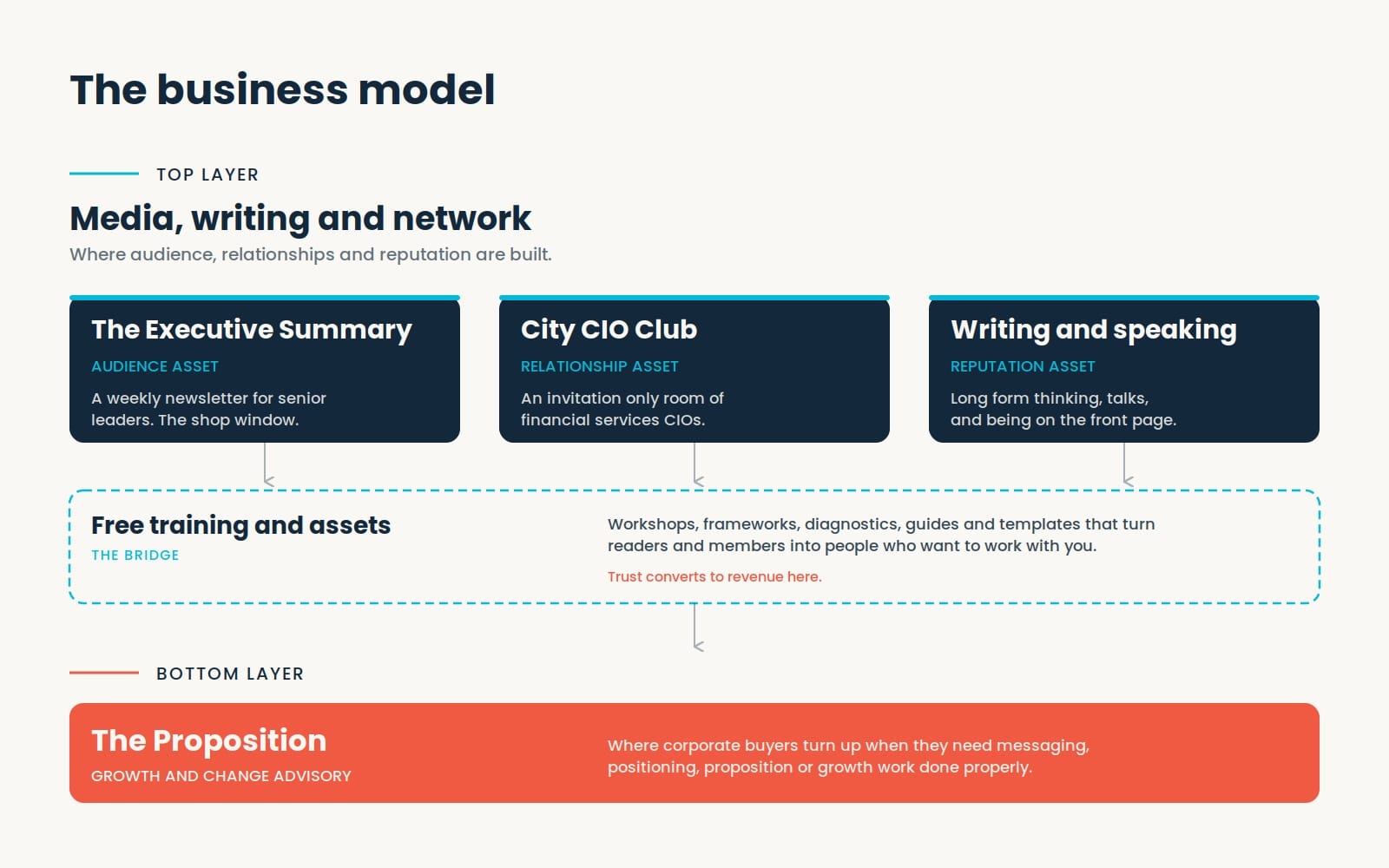
My business model relies on creating trust by giving good content and learning tools to business leaders for free.
The Executive Summary is an audience asset. It puts thinking in front of FTSE senior leaders every week. The City CIO Club is a relationship asset. It's an invitation only room where the people I want to know spend time with each other. The Proposition is a revenue asset. It's where corporate buyers turn up when they need messaging, growth strategy or proposition work done properly.
The newsletter builds the audience that some readers convert from into CIO Club members. The Club generates the conversations that feed the newsletter.
Newsletter readers who run growth or marketing or strategy become Proposition prospects.
The AI stack is what makes a small operation like this far more scalable. The work that's mine gets done by me and the work that isn't gets done by the system.
I've given a few talks on AI this year and I needed to be on top of my game. As chair of the City CIO Club I see leaders who haven't done anything like this because they don't have the time.
Building it myself was essential learning. It also gave me the ability to connect the stack and make changes to websites, designs, features and API connections without a web developer.
We're about to add a new section to The Proposition on change. That section took an hour to write and put up.
Shop front
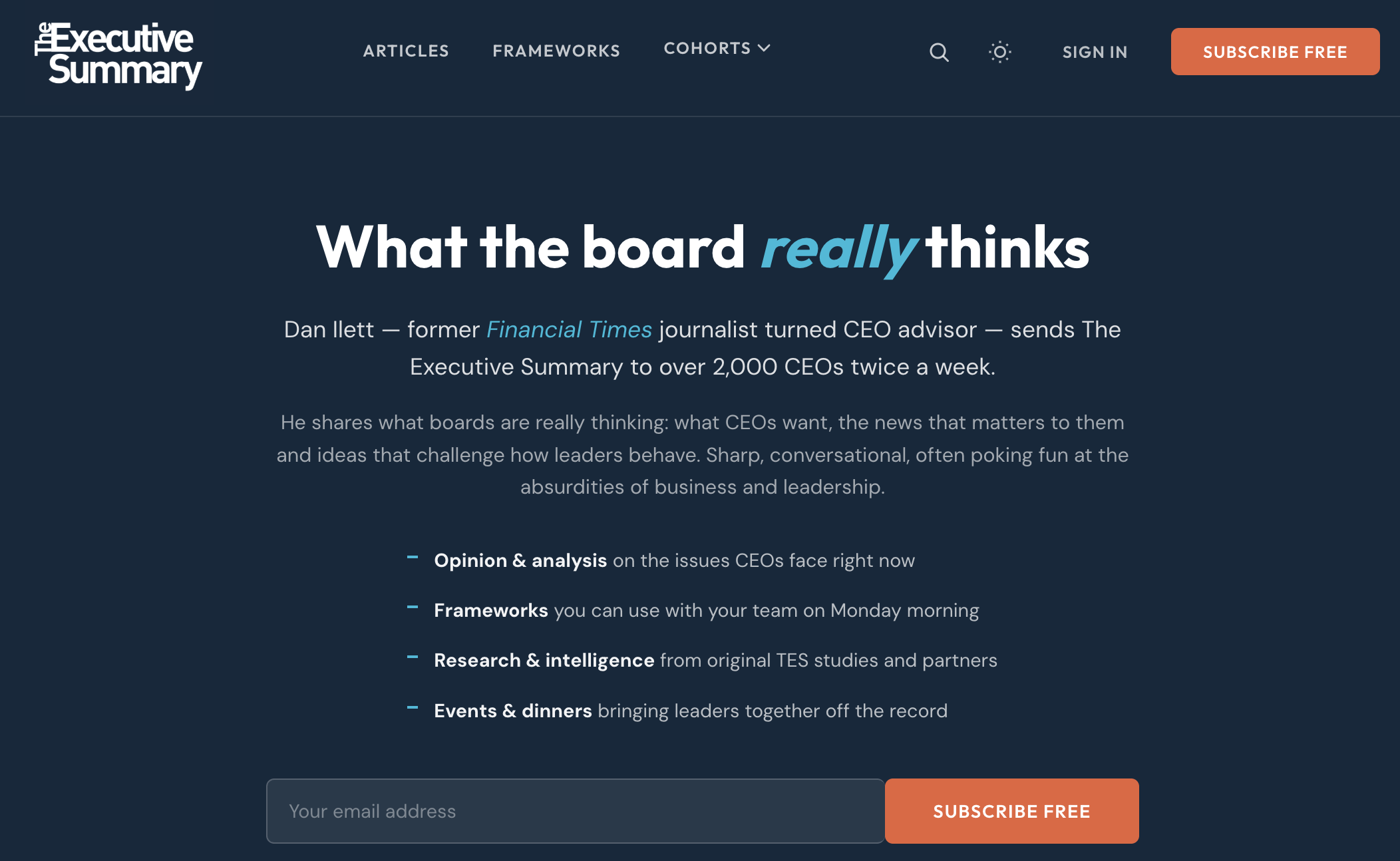
Everything you see on the public facing side of my business now runs through Claude.
The new Executive Summary site has been designed and built by Claude, which means I can connect it to a lot of services. It is no longer hosted on Ghost at £60 a month.
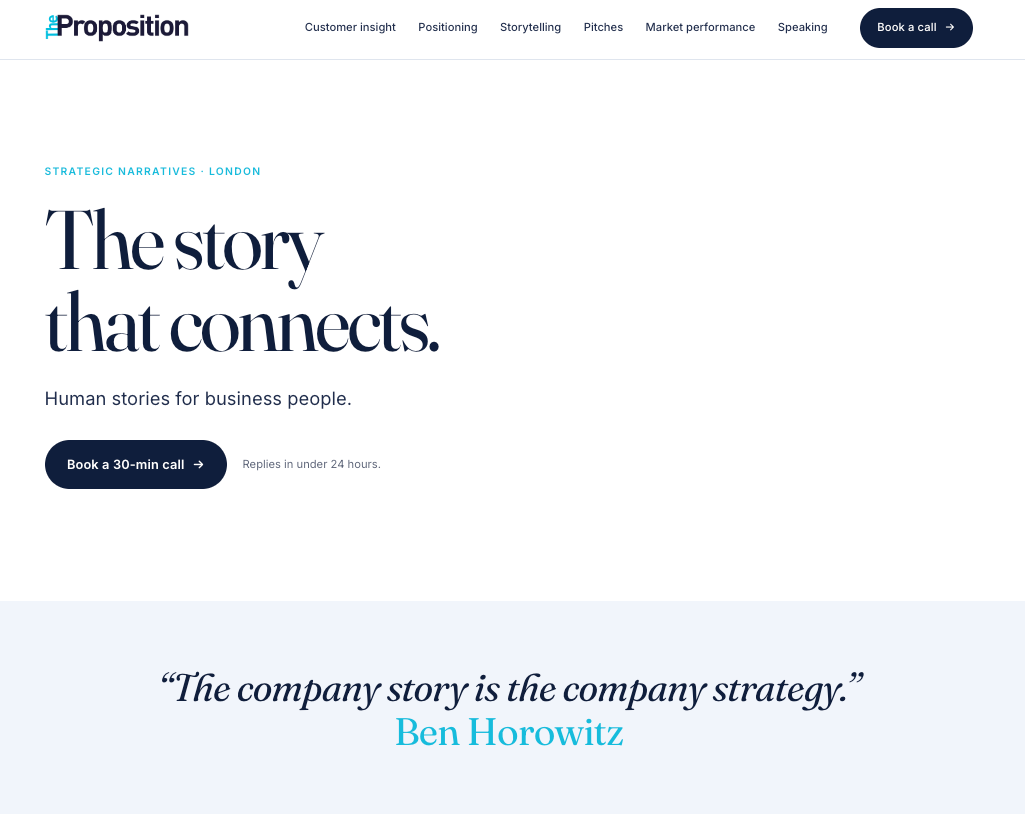
The Proposition website is also built and managed by Claude. We can spin up new products and offerings in minutes rather than weeks. In other words, I do not need a content management system any more. I just talk to my agent.
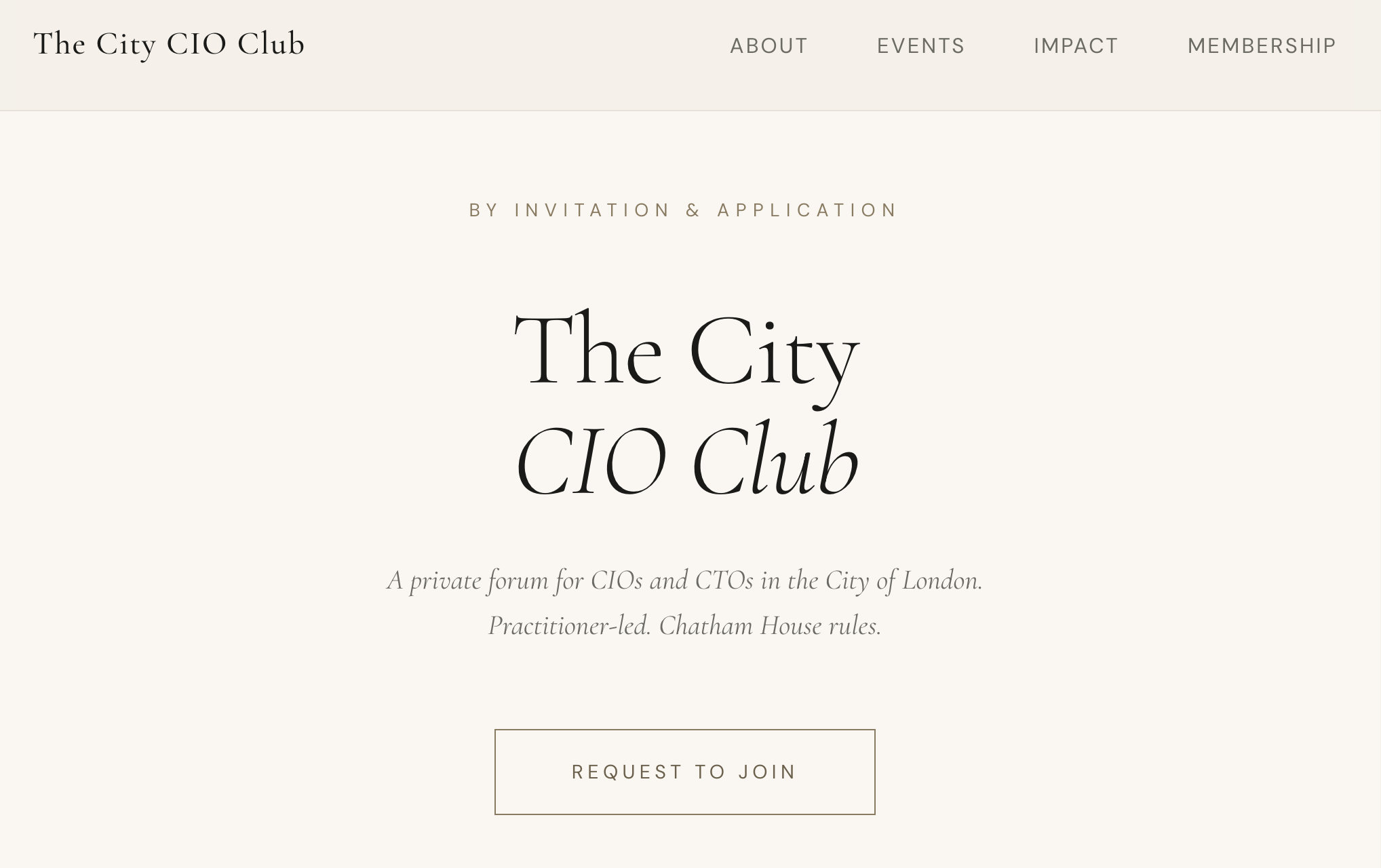
The City CIO Club site is in the same environment. Applications arrive from CIOs or vendors and my team of agents decides what to do next.
Starting out
Before I committed to this model I had to find out if it was safe. I first set up an environment to build all of this on.
I then tested it on an old news website I built years ago, Greenbang. Moving the website was a little fiddly as I am not a techie, but once I got my head around it, it wasn't too bad. All 5000+ articles, photos and links came over with no trouble.
I then built a workflow that assesses AI infrastructure and energy press releases and helps select which articles to write about.
Value added: a retired media asset back in action with very little work
Once I knew I wasn't going to break the internet, I removed the training wheels and moved the other sites to my new environment. This in total saved £120pm on Ghost (the content management system) and £50pm on Wordpress hosting.
My team
The main agent looking after this layer is Marvin. He's a project manager and a variation of Claude Code. Unlike the Claude app on your phone or desktop, he can do things on a schedule without me prompting, like send reminders, to-do updates and news updates. And he keeps going on them.
You may have heard of OpenClaw. Marvin is built in that style. Both work the same way: run an AI agent locally that can reach out to you across messaging apps, work on a schedule, and take action without you needing to start the conversation.
If I gave Marvin an email address he could accept and route enquiries like a PA. I don't let him send any emails or go live with anything, but the option is there.
People are doing this with voice tools too. One operator rigged up an agent to phone every pub in Ireland to get the price of a Guinness across the country. Once the results were published and the news outlets got hold of the story, it brought down the price across the board. The point is that agents now do work that used to be impossible to scale, and they do it cheaply.
Marvin keeps on top of tasks across all the projects, flags what needs attention, and increasingly helps me work out where to focus my sales effort. Every morning I get my reminders from Nicky, another agent, on Telegram so we can chat rather than having to use the Claude app.
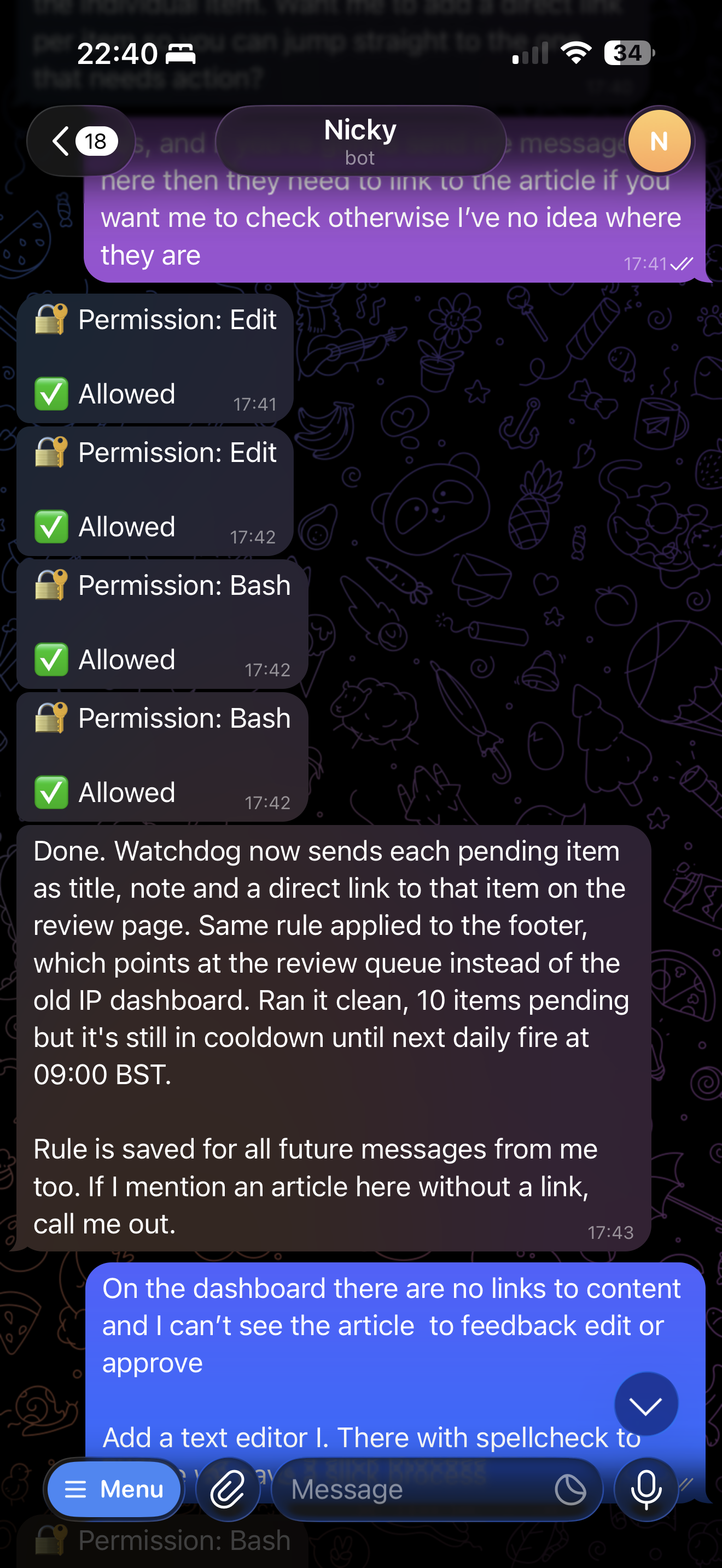
Behind Marvin there is an editorial team helping me pull relevant articles, do the thinking, edit drafts, and check for libel and facts. I write The Executive Summary, but I use a team to ensure I've got it right.
Then there is Ron, the editor agent. Under Ron there is TES Ed, the researcher, and Mary, a really fussy detail oriented agent who won't let anything go live that doesn't stack up for facts. I like Mary the most because she is trained to triple source check everything.
I named them all because I am a schoolboy at heart and it helps me to remember who is doing what.
None of the agents have permission to publish or send. Scott is in charge of SEO and GEO, the AI equivalent of SEO. He's currently broken.
I'm onboarding analyst agents now to run the growth side, finding companies to bring into the TES world and watching for the moments where a thoughtful approach would land.
I run the thinking, the writing, the relationships and the consultancy.
A lazy no coder
Worth saying clearly before I go further. I'm not a coder. I picked up a Cisco Certified Network Professional qualification back in 2000 and used to program routers for the London Metal Exchange.
While I am no developer, I am really good at defining the destination and writing very clear briefs. This in AI language is called prompting and there are many hacks to becoming skilled in it.
If you can write a clear brief, you can run this stack. The key is being clear with your design.

Sourcing technology to turn strategy into reality
Proudly sponsors the Executive Summary
Oven-ready skills
GitHub is where coders share and store their work. What's exploded recently is the number of skills files for Claude held there.
These are pre-built prompts for jobs or tasks, written by other people and given away free. If you want a marketing team, an analyst team or a project management team, someone has probably already built a version of it and shared it.
This used to be a coder only world. It isn't any more. The barrier to using these tools is now reading English and being willing to test things until they work. That's it.
The other day the team at Motorway published a complete team of analysts, researchers, coders, product testers and project managers for the world to use. They mentioned it on LinkedIn so I told them I'd test it. Claude stripped out what I didn't need and deployed the rest. It's pretty good for running Agile work and better than the Kanban board I was using.
The point is not Motorway specifically. The point is that the tools, teams and templates that used to live behind a wall of code are now sitting in plain sight, free, and ready to be plugged in by someone like me. That changes what a small business can do.
You should now go and check out what marketing skills you can use from Github. You can build an entire agency of agents.
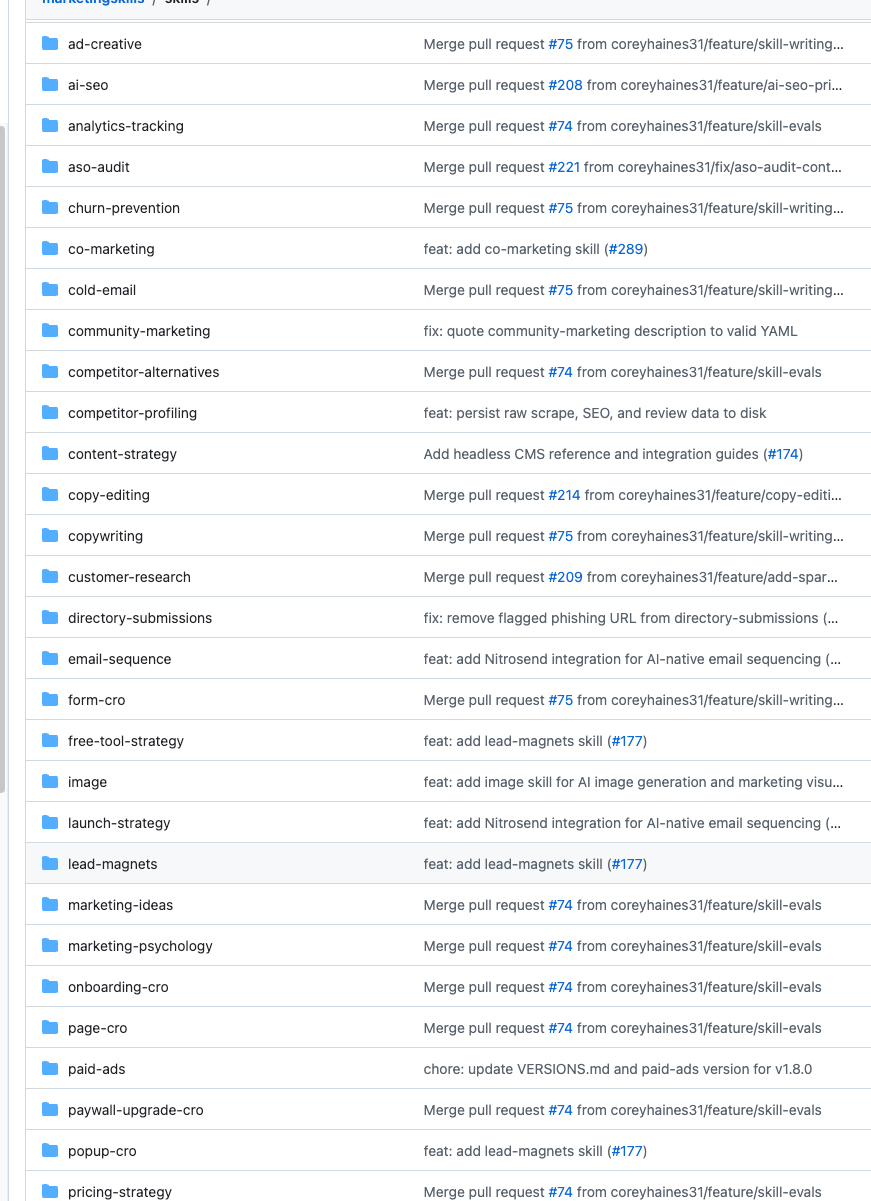
Health warning: skills files vary in quality. Most of mine I've adapted rather than used as is. But once you have a workable formula, you can create and test in volumes that weren't possible before. Fail faster, find what works, then go bigger.
But... keep it simple/.
Talking to Marvin and team
The piece that makes all of this practical is plumbing it into Telegram. I can build, develop, edit and ship while I'm on the move. If I'm waiting for one of the boys at a sports lesson or watching a match from the sideline, I can build a new web page.
The new Proposition website took a day and a half to make, edits included. That number would have been weeks not long ago.
Start building
The only way to do this - if you haven't already begun - is to start. Get Claude out, watch Youtube and put in 30 mins a day.
You can build a scalable operation without being a coder, a big team or spending a fortune.
Email me if you get stuck.
Have fun with it.
Dan

Dan Ilett is a specialist in CEO storytelling and growth advisory. His work has shaped $1bn in closed deals. He has advised IBM, Google, Microsoft, Cisco, Cognizant, Equinix, UK Government, Virgin Money, SEB and many more.
He has coached Fortune and FTSE CEOs on the commercial narrative, the speech and the media handling that surround the highest-stakes moments: crisis, change, product launches, growth milestones, fundraises and exits. He chairs the City CIO Club, a private network for technology leaders.
He came up through journalism, writing for the Financial Times, Economist Group, Daily Telegraph, New York Times and a string of tech publications. He went on to launch his own, founding Greenbang (cited by the UN and European Commission) and CoinDesk, where he was founding editor. He has also worked in FTSE transformation, commercial delivery and digital media companies, shaping governance and controls.
With AI such a hot topic, he edits and publishes The Executive Summary, an enterprise AI, growth and business life, a weekly briefing for 2,000+ CEOs.